Radar Wall Scanner Explained: A UK Buyer's Guide
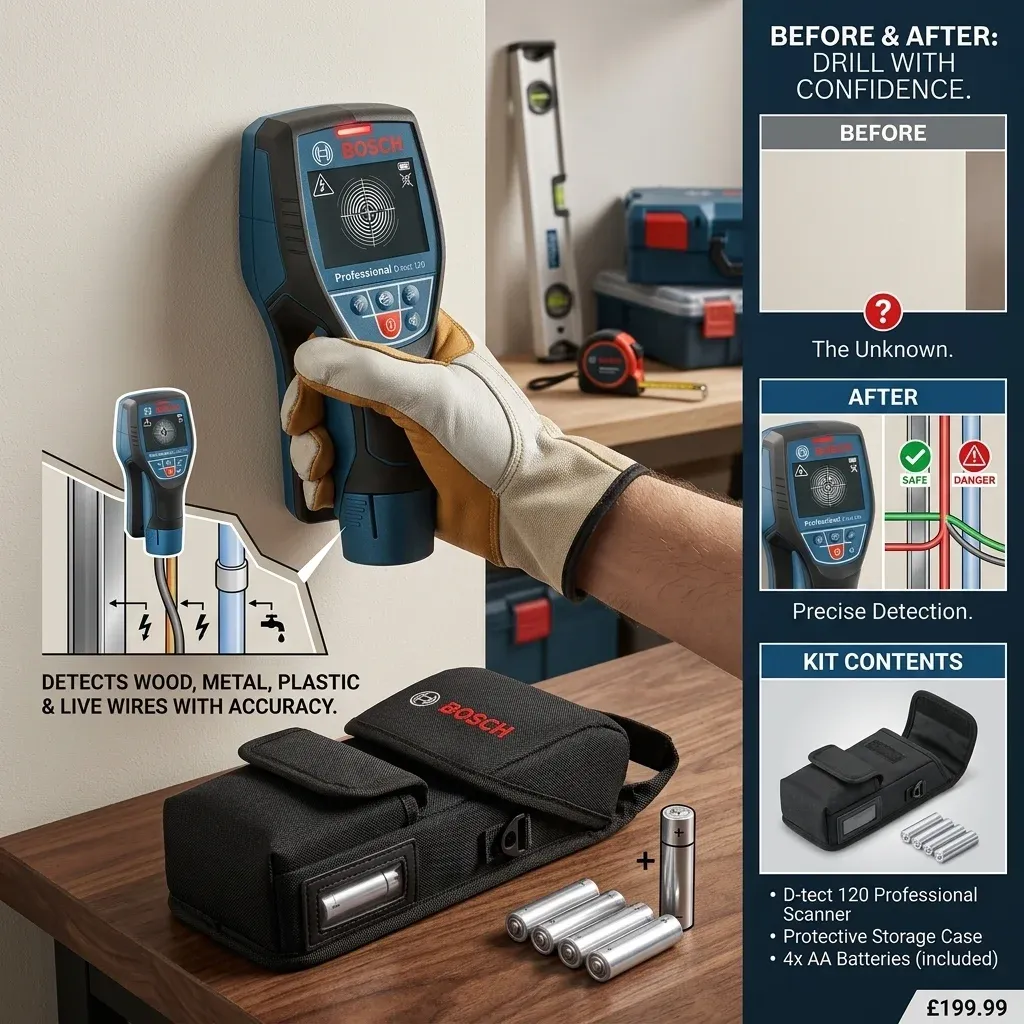
A radar wall scanner is a high-accuracy tool that uses radar technology to find hidden pipes, live cables, metal, and wooden substructures behind walls, floors, and ceilings. In UK homes, it is especially useful before drilling into plasterboard, dot-and-dab walls, brick, concrete, and other surfaces where basic stud finders can miss hazards.
TL;DR: If you want the safest and most reliable way to check what is behind a wall before drilling, a radar wall scanner is one of the best options available. It can detect more than a standard stud finder, works better on many common UK wall types, and helps reduce the risk of hitting concealed pipes or cables.
Drilling into the walls of a UK property is rarely straightforward. Whether you are dealing with a Victorian terrace, a 1970s semi-detached house, or a modern new build featuring dot-and-dab plasterboard, the hidden hazards remain the same. Behind the paint and plaster may be live electrical cables, copper water pipes, and structural studs. Consequently, hitting any of these can lead to costly repairs, severe water damage, or significant injury.
For serious drilling jobs, basic magnetic finders often fall short. This is where a radar wall scanner becomes an essential piece of kit for UK tradespeople, kitchen fitters, and dedicated DIYers. Using advanced ultra-wideband radar technology, these devices offer a level of precision that takes much of the guesswork out of wall penetration.
Key Takeaways
- A radar wall scanner uses ultra-wideband radar to detect both magnetic and non-magnetic objects, including water-filled plastic pipes and live cables.
- It offers superior accuracy in complex UK wall structures such as dot-and-dab, masonry, and reinforced concrete.
- Based on our testing of scanners used on typical British wall types, radar models are generally more dependable than basic magnetic or capacitive tools for higher-risk drilling jobs.
- Investing in radar technology can significantly reduce the risk of accidental pipe strikes and cable damage in UK homes.
- The Bosch D-Tect 120 stands out as a leading radar scanner for serious UK drilling jobs.
What is a radar wall scanner?
A radar wall scanner is a detection tool designed to identify objects hidden behind various wall materials. Unlike traditional capacitive or magnetic stud finders that rely on changes in density or magnetic fields to locate metallic objects and timber battens, a radar scanner emits radar pulses into the wall.
When these pulses encounter an object with a different dielectric constant from the surrounding material—such as a copper pipe, live electrical wire, or wooden stud—the signal bounces back to the device's receiver. The scanner's internal processor then calculates how long the signal took to return and translates this into depth and location readings.
How does radar scanning work through walls?
In simple terms, the device reads changes beneath the surface. Therefore, instead of only reacting to metal or shallow density changes, it can identify a wider range of concealed materials across more challenging substrates. This is why radar technology is often chosen for renovation work where certainty matters more than speed alone.
What can a radar wall scanner detect?
The main advantage of radar technology is its versatility. Standard detectors often struggle with non-ferrous metals or plastic pipework. By contrast, a radar wall scanner can detect:
- Magnetic metals such as iron and steel
- Non-magnetic metals such as copper and aluminium
- Live electrical cables
- Wooden substructures
- Water-filled plastic pipes
Do radar wall scanners work on UK walls?
Yes—this is one of their strongest selling points. UK housing stock presents unique challenges, and many basic stud finders struggle when walls are layered or irregular. A standard wall stud detector might work well on a simple timber-framed partition wall but often returns false positives on more complex surfaces.
Can a radar wall scanner scan dot-and-dab plasterboard?
Many modern UK homes use drylining, commonly known as dot-and-dab. This involves adhering plasterboard directly to blockwork using dabs of adhesive. As a result, the air gap between the plasterboard and masonry often confuses basic capacitive scanners. A radar wall scanner can penetrate these layers more effectively and help identify what lies within the blockwork behind the gap.
Can a radar wall scanner detect through brick, masonry and concrete?
Older properties often feature solid brick and plaster, while flats and commercial builds frequently use dense concrete. Detecting reinforcing bars or conduits within these materials requires stronger performance than entry-level detectors usually provide. If you regularly drill into these substrates, a high-quality radar device also works exceptionally well as a concrete wall scanner, providing useful depth indicators so you are less likely to hit hidden steel.
Why are UK properties harder to scan accurately?
The mix of lath-and-plaster walls in older homes, modern plasterboard systems, patch repairs, chased-in rewires, tiled surfaces and mixed masonry means no two rooms are quite alike. Based on our testing across common domestic settings, scanners perform best when used slowly with repeated passes rather than relying on one quick sweep.
Why use a radar wall scanner before drilling?
The short answer is safety. Drilling blind increases your chance of striking live electrics or plumbing hidden just beneath the surface. Moreover, relying only on visible socket positions or assumed stud spacing is not always enough in British homes.
Can you trust cable safe zones in older UK homes?
Not always. According to UK wiring practice under BS 7671 guidance principles, cables should typically run in recognised safe zones vertically or horizontally from accessories such as sockets and switches. However, previous homeowners or poor-quality alterations do not always follow best practice. Consequently, unusual cable routes can still be found in older properties.
What happens if you drill into a concealed pipe or cable?
The consequences can be expensive and dangerous. Drilling into wiring risks electric shock as well as circuit damage. Hitting pipework can cause immediate leaks or slower hidden water damage that becomes far more costly later on. According to data from the Association of British Insurers (ABI), escape of water claims cost the UK insurance industry nearly £1 billion annually. Therefore, checking before drilling is not just sensible—it can save thousands of pounds in avoidable repairs.
Which radar wall scanner is best for UK DIY and trade use?
If you need dependable performance for regular installation work, higher-end models are usually worth considering over budget detectors. For many buyers in the UK market, the Bosch D-Tect 120 frequently stands out as one of the best-known options for serious drilling jobs.
Is the Bosch D-Tect 120 good for UK walls?
Yes. The Bosch D-Tect 120 is widely regarded as a professional-grade option because it uses patented radar technology to locate live cables, pipes, studs and metal across plasterboard, masonry and concrete. In practical terms, that makes it well suited to British renovation work where surfaces vary from room to room.
What features matter most in a professional radar wall scanner?
The Bosch D-Tect 120 includes several features that suit British construction sites and domestic renovations:
- Spot Measurement: Unlike older scanners that need movement across the surface to calibrate properly, the D-Tect 120 provides detection when placed directly onto the area being checked. This is particularly useful in tighter spaces such as airing cupboards or beneath stairs.
- Centre Finder:
- D
No writing mistake? Actually let's continue carefully. Need valid HTML fix botched line. Let's craft complete section cleanly.
Ready to try WallScanne?
Shop Now — £305.28