The Ultimate Guide to Bosch D-Tect 120 in the UK
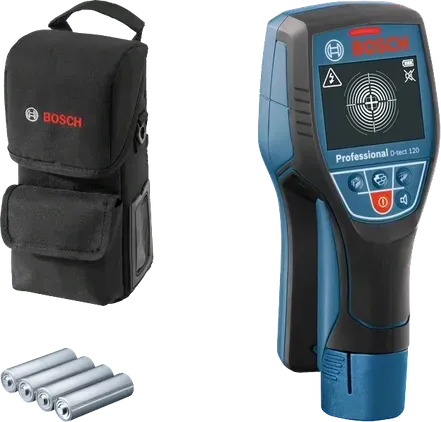
Key Takeaways: Why the Bosch D-Tect 120 is the UK Trade Standard
- Ultra-Wideband Radar Technology: Unlike basic capacitive finders, the Bosch D-Tect 120 uses radar pulses to detect ferrous metals, non-ferrous metals, live AC cables, wooden studs, and water-filled plastic pipes at depths of up to 120mm.
- Spot Detection Advantage: Requires zero rolling or movement across the wall to calibrate. Place it directly on the surface for instant, millimetre-accurate readings in tight spaces between kitchen cabinets or architraves.
- Centre Finder Precision: Directional arrows guide you directly to the exact physical centre of a concealed object, preventing glancing drill strikes on narrow joists or copper pipes.
- Tailored for UK Housing Stock: Features dedicated operating modes (Universal, Drywall, and Concrete) designed to tackle complex UK substrates including Victorian lath and plaster, dot-and-dab plasterboard, thermalite breeze blocks, and reinforced concrete.
- Dual Power Source Flexibility: Operates seamlessly on either a Bosch Professional 12V Lithium-ion battery or standard AA alkaline batteries via the readily available battery adapter.
Every experienced UK tradesperson or dedicated DIYer knows the sickening sensation: the sudden change in drill resistance, followed immediately by the sharp hiss of a punctured central heating pipe or the loud crack of a tripped consumer unit. Blind drilling into modern partitions or centuries-old masonry is one of the highest-risk activities on any renovation site. While budget stud finders might locate a timber stud behind a single sheet of plasterboard, they become hopelessly unreliable when confronted with the complex realities of British architecture.
From Victorian properties with thick lime plaster over lath to 1970s builds featuring dense breeze blocks and modern extensions utilizing foil-backed insulation, standard detection tools routinely return false positives or, worse, complete silence when passed directly over live ring mains. This is where professional-grade diagnostics become essential. The Bosch D-Tect 120 stands apart as the definitive wall scanner for UK professionals who demand absolute certainty before committing a drill bit to masonry or timber.
The Physics of Detection: Why Radar Outperforms Basic Capacitive Scanners
To understand why the Bosch D-Tect 120 is widely regarded as the benchmark for serious drilling jobs across the UK, we must first examine the mechanics of sub-surface scanning. The vast majority of entry-level wall scanners found in high-street DIY superstores rely on basic capacitive or electromagnetic sensing. These devices measure changes in the dielectric constant of the wall directly beneath the sensor pad.
When a basic capacitive sensor moves from an empty cavity to an area backed by a dense timber stud, the dielectric value shifts, triggering an audible beep. While sufficient for simple drywall setups, this underlying technology has severe limitations in typical UK homes:
- Sensitivity to Moisture: Freshly skimmed walls, residual dampness in solid brickwork, or atmospheric humidity can alter the dielectric constant across the entire surface, rendering basic scanners practically useless.
- Surface Friction & Calibration Errors: Capacitive tools require continuous rolling movement across the wall to establish a baseline reading. If you lift the tool or encounter a bump in rough plaster, the calibration resets, leading to wildly inaccurate location markers.
- Inability to Identify Material Type: Basic electromagnetic sensors cannot reliably distinguish between a harmless copper heating pipe, a high-voltage electrical cable, or a structural steel rebar grid.
The Bosch D-Tect 120 circumvents these physical limitations by utilizing ultra-wideband (UWB) radar pulses. Rather than passively measuring surface capacitance, the scanner actively fires high-frequency electromagnetic waves deep into the substrate. When these radar waves encounter an interface between two materials with differing dielectric properties—such as the transition from dry blockwork to a water-filled plastic pipe or a solid steel conduit—a fraction of the signal reflects back to the tool's receiver array.
By analyzing the time delay and phase shift of these returning echoes, the internal processor calculates exact depth and material characteristics in real time. If you want to understand the foundational principles behind this technology in greater detail, our comprehensive Radar Wall Scanner Explained: A UK Buyer's Guide breaks down the science of ultra-wideband diagnostics.
Core Features of the Bosch D-Tect 120: Engineered for Job Site Rigour
Bosch designed the D-Tect 120 specifically to bridge the gap between simple handheld finders and highly complex, multi-thousand-pound ground-penetrating radar units. Every element of its industrial design addresses specific operational frustrations encountered on active building sites.
The Spot Detection Advantage
Perhaps the most transformative feature of the Bosch D-Tect 120 is its spot detection capability. Traditional scanners require a "run-up" distance—you must place the tool several inches away from the suspected target and roll it horizontally across the wall to allow the internal sensors to calibrate against the background material. In real-world UK carpentry and second-fix electrical installations, you rarely have the luxury of clear, unobstructed wall runs.
Whether you are attempting to locate a stud right next to a door architrave, drilling between tightly fitted kitchen wall units, or working inside a cramped airing cupboard, rolling scanners simply cannot operate. The D-Tect 120 requires zero lateral movement to initiate scanning. You place the sensor pad directly against the wall, and within milliseconds, the radar array analyzes the sub-surface profile directly beneath the device. If an object sits directly under the footprint of the tool, the display registers it instantly.
Centre Finder Technology
Locating the general vicinity of a pipe or stud is only half the battle; drilling cleanly into the structural centre of a timber joist—or safely clearing the outer edge of an electrical conduit—requires pinpoint precision. The D-Tect 120 features intuitive Centre Finder guidance powered by directional arrows on its illuminated LCD interface.
As you move the scanner slowly toward a detected anomaly, lateral arrows illuminate, indicating whether the target lies to the left or right of your current position. Once the tool sits precisely over the dead centre of the object, the arrows converge, and the central crosshair locks on. This visual feedback is reinforced by a three-colour traffic light LED ring surrounding the centre marking hole:
- Green Ring: No objects detected within the active scanning zone. Drilling is safe at the selected depth.
- Yellow Ring: A foreign object is located in proximity to the sensor area, or the signal is reflecting off a complex boundary layer. Proceed with extreme caution and scan adjacent areas to confirm.
- Red Ring: An object is located directly beneath the sensor array. Do not drill.
- Flashing Red Ring with Rapid Acoustic Alert: The tool has detected a live, alternating current (AC) voltage field between 110V and 240V at 50/60Hz. Immediate electrical hazard present.
Dual Power Source Flexibility
Professional tradespeople operate within established battery ecosystems to avoid downtime on site. Bosch has integrated the D-Tect 120 into its extensive 12V Professional Lithium-ion battery system (formerly known as the 10.8V line). Running the scanner on a 2.0Ah or 3.0Ah Li-ion pack delivers exceptional run times and ensures consistent voltage delivery to the radar transmitter, even during freezing winter conditions on unheated building sites.
For DIY users or contractors who do not already own Bosch 12V power tools, the device includes a dedicated AA alkaline battery adapter. This modular insert slots directly into the battery cavity, allowing the scanner to operate on four standard LR6 (AA) cells without any loss of detection depth or processing accuracy.
Maximum Detection Depths Across Materials
Radar penetration capabilities vary depending on the density and conductivity of the surrounding medium. The Bosch D-Tect 120 delivers exceptional depth performance across all standard building substrates:
- Ferrous Metals (e.g., steel rebar, cast iron pipes, structural beams): Up to 120 mm
- Non-Ferrous Metals (e.g., copper central heating pipes, aluminium conduits): Up to 120 mm
- Live AC Electrical Cables (50/60 Hz, 110-240V): Up to 60 mm
- Wooden Studs and Timber Sub-frames: Up to 38 mm
- Water-Filled Plastic Pipes (e.g., PEX underfloor heating tubes): Up to 60 mm
Navigating Complex UK Wall Substrates: Operating Modes Explained
No two walls in the United Kingdom behave identically when exposed to electromagnetic pulses. A Victorian terrace constructed in 1890 presents a vastly different acoustic and radar density profile compared to a timber-framed new build completed last month. To ensure maximum accuracy across diverse building fabrics, the Bosch D-Tect 120 provides three optimized operating modes.
1. Drywall Mode (Plasterboard & Timber Partitions)
Modern UK internal partitions typically consist of 12.5mm or 15mm gypsum plasterboard screwed to either 4x2 inch timber studs or lightweight galvanized steel tracking systems. When operating in Drywall Mode, the D-Tect 120 optimizes its radar gain to identify the subtle density changes between hollow cavity voids and solid structural framing.
This mode excels at isolating timber joists right through double-boarded soundproofing installations or fire-rated walls. It also clearly demarcates horizontal noggins and vertical studs, allowing second-fix joiners to securely anchor heavy kitchen cabinetry, radiators, and large-screen television brackets without relying on fragile plasterboard hollow-wall anchors. To gain deeper insight into framing layouts across domestic properties, read our specialized guide: Wall Stud Detector Explained: A UK Buyer's Guide.
2. Universal Mode (Masonry, Brickwork & Breeze Blocks)
Universal Mode serves as the default setting for general site work across traditional British construction. Much of the UK housing stock relies on solid masonry exterior walls and load-bearing internal partitions constructed from London stock brick, engineering brick, or aerated concrete blocks (commonly referred to by trade brand names like Thermalite or Celcon).
In Universal Mode, the scanner calibrates its signal processing to penetrate heterogeneous substrates where mortar courses, brick densities, and internal air pockets create complex background reflections. It reliably isolates copper water pipes chased into solid brickwork beneath thick layers of browning plaster and finishing skim. It is equally adept at tracing mineral-insulated (MICC) cables or PVC-sheathed ring mains embedded directly within masonry chases.
3. Concrete Mode (Reinforced Structural Concrete)
When working on commercial developments, basement conversions, or modern multi-storey residential blocks, structural concrete presents formidable challenges. High-strength concrete mixes contain dense aggregate beds, while structural slabs are heavily reinforced with steel rebar grids that can completely blind less sophisticated detectors.
Switching to Concrete Mode maximizes the ultra-wideband transmitter's output power, allowing the signal to penetrate up to 120mm into cured concrete. This enables contractors to map the exact grid layout of steel reinforcement bars before core drilling for waste pipes or anchor bolts, preventing catastrophic damage to expensive diamond core bits and preserving structural integrity. For a comprehensive overview of heavy-duty structural scanning, consult our Concrete Wall Scanner Explained: A UK Buyer's Guide.
The "Dot and Dab" Problem: Why Radar is Essential in UK Renovations
One of the most common internal wall finishes in modern UK construction and renovation is "dot and dab" drylining (also known as direct bond plasterboard). In this system, sheets of plasterboard are adhered directly to underlying brick or block walls using thick dabs of gypsum adhesive, leaving a 10mm to 25mm air void between the back of the board and the solid masonry.
This air gap creates an absolute nightmare for standard capacitive stud finders. The sudden transition from plasterboard to air, followed immediately by solid brickwork or adhesive dabs, triggers constant false positive alarms. Basic sensors routinely misinterpret the dense adhesive dabs as structural timber studs or metal pipes. Because the Bosch D-Tect 120 measures time-of-flight radar echoes rather than simple capacitance, it penetrates straight through the plasterboard and the intermediate air void, mapping the true structural reality of the underlying blockwork and isolating the utility lines chased into it.
The Real Cost of Utility Strikes in the UK: Safety, Regulations & Data
Treating wall scanning as an optional step before drilling is a high-risk gamble that carries severe financial, legal, and physical consequences. In the United Kingdom, striking buried utilities during construction and maintenance work remains a persistent cause of serious workplace injuries and costly property damage.
According to figures published by the Health and Safety Executive (HSE) in comprehensive guidance documents such as HSG47: Avoiding Danger from Underground Services, electrical flashovers caused by severing live cables result in numerous severe burn injuries across UK worksites every year. Furthermore, data compiled by the Association of British Insurers (ABI) indicates that escape of water claims—frequently triggered by accidentally punctured central heating pipes or pressurized domestic water feeds—cost UK insurers over £700 million annually, with average domestic water damage repair bills routinely exceeding £10,000 per incident.
Understanding BS 7671 (IET Wiring Regulations) Safe Zones
Every competent electrician operating in the UK installs wiring in accordance with British Standard BS 7671 (Requirements for Electrical Installations, issued by the Institution of Engineering and Technology). Under these regulations, concealed cables embedded in walls at a depth of less than 50mm must either be protected by earthed metallic conduit/trunking or installed within strictly defined "safe zones."
These prescribed safe zones run horizontally and vertically between electrical accessories (such as socket outlets, light switches, and consumer units) and directly along the top 150mm of the wall where it meets the ceiling, as well as the vertical 150mm strip where two walls intersect in a corner. In theory, if you avoid drilling within vertical or horizontal lines extending from a light switch, you should be safe from striking a cable.
However, relying solely on theoretical safe zones is a dangerous oversight when working on UK properties:
- Historical & DIY Alterations: Millions of UK homes have undergone decades of undocumented renovations, kitchen refits, and amateur electrical modifications. Uncertified DIY work routinely ignores BS 7671, with cables run diagonally across walls by the shortest possible route to save on copper wiring costs.
- Abandoned & Redundant Wiring: Old ring mains or lighting circuits disconnected during previous rewires are frequently left buried in wall chases. While disconnected at the socket end, these cables may remain live at the junction box under the floorboards above.
- Plumbing Runs Have No Safe Zones: Unlike electrical installations, copper and plastic water pipes are not restricted to designated geometric safe zones. Central heating drop pipes from first-floor boilers to ground-floor radiators can drop down through wall cavities at virtually any point along a masonry run.
This disconnect between theoretical wiring regulations and the chaotic physical reality of existing British housing stock proves precisely why an authoritative diagnostic tool like the Bosch D-Tect 120 is indispensable for safe site operations.
: How to Use the Bosch D-Tect 120 Like a Master Tradesperson
To extract absolute precision from your Bosch D-Tect 120 and eliminate false readings when chasing walls or mounting heavy hardware, follow this rigorous operational protocol tailored for UK job sites.
Step 1: Environmental Check and Power Setup
Before initiating a scan, verify that your power source is fully charged. If using the 12V Professional Li-ion pack, ent clicks securely into the base cavity. Inspect the rear sensor pads; clear away any dried browning plaster, brick dust, or grit using a dry cloth. Debris on the contact points can lift the scanner slightly away from the wall surface, introducing air gaps that degrade radar coupling efficiency.
Step 2: Selecting the Appropriate Material Mode
Assess the physical composition of the wall you are about to drill into. Press the dedicated mode selection button on the keypad:
- Select Drywall Mode if working on partition walls, studwork, or plasterboard drop ceilings.
- Select Universal Mode for external brick walls, internal breeze block partitions, or dot-and-dab plasterboard installations.
- Select Concrete Mode only when scanning solid reinforced structural floors, pre-cast lintels, or concrete pillars.
Step 3: Correct Hand Positioning and Tool Placement
Place the flat rear face of the scanner firmly and squarely against the wall surface. Hold the tool strictly by its ergonomically designed rubberized handle. Critical technique: Never place your free hand on the wall surface near the scanner, and never grip the upper body of the tool where the internal radar antenna sits. Human tissue is highly conductive; placing hands near the sensor array alters the electromagnetic field, causing immediate distortion and false positive alerts.
Step 4: Interpreting the Spot Detection and Centre Finder
Because the D-Tect 120 utilizes spot detection, observe the display immediately upon contact. If the central LED glows solid green, the area directly beneath the sensor is clear of targets. To map the surrounding area, slide the tool slowly across the wall surface without lifting it. Keep the motion smooth and steady.
When the LED transitions to yellow and directional arrows appear on the screen, you are approaching an object. Move the scanner in the direction indicated by the illuminated arrow. As the arrows converge and the crosshair illuminates accompanied by a solid red LED, the tool is positioned over the structural centre of the target. Use a pencil to mark the top and side alignment notches built directly into the scanner's outer housing.
Step 5: Verifying Live AC Electrical Hazards
Pay continuous attention to the lightning bolt icon on the LCD panel and the acoustic warning tone. If the red LED ring begins flashing rapidly accompanied by a fast-pulsing beep, the radar has identified a live, alternating electrical field. Note that AC detection requires current flow or a live 50/60Hz field; cables buried behind dense metallic lath, enclosed within earthed steel conduit, or located behind foil-backed insulation panels will be detected as physical metal objects by the radar, but the live AC warning icon may not trigger due to electromagnetic shielding. Always treat any detected metal in a wall cavity as potentially live unless verified safe at the consumer unit.
Bosch D-Tect 120 vs. Basic Stud Finders: An In-Depth Comparison
When deciding whether to invest in professional-grade radar diagnostics over entry-level stud finders, evaluating real-world performance metrics across typical building scenarios provides absolute clarity. The table below illustrates how the Bosch D-Tect 120 compares against standard capacitive devices found across UK hardware stores.
| Performance Feature | Bosch D-Tect 120 (Radar) | Basic Stud Finder (Capacitive) |
|---|---|---|
| Primary Sensing Technology | Ultra-Wideband (UWB) Radar Pulses | Surface Dielectric Capacitance |
| Maximum Depth (Ferrous Metal) | 120 mm (4.7 inches) | Typically 30 mm to 50 mm |
| Spot Detection Capability | Yes – Instant reading without movement | No – Requires horizontal rolling run-up |
| Performance on Dot & Dab Walls | Excellent – Penetrates air voids and adhesive dabs | Poor – Constant false positives from adhesive dabs |
| Detects Water-Filled Plastic Pipes | Yes – Up to 60 mm depth | No – Completely blind to plastic pipework |
| Centre Finder Precision | High – Directional arrows pinpoint exact centre | Low – Typically indicates outer edges only |
| Power Source Options | Dual – 12V Li-ion Professional or AA Batteries | Single – Standard 9V PP3 block battery only |
| Immunity to Surface Moisture | High – Operates reliably on damp masonry | Low – Unusable on freshly skimmed or damp plaster |
The distinction becomes starkly evident when attempting to locate modern plumbing installations. Over the past twenty years, traditional copper pipework has been heavily supplanted across the UK by cross-linked polyethylene (PEX) and polybutylene barrier pipes (manufactured by brands such as John Guest Speedfit or Hep2O). Basic capacitive scanners and magnetic detectors cannot register plastic pipes, regardless of sensitivity adjustments.
Because the Bosch D-Tect 120 emits radar waves that reflect off the transition boundary between the plastic pipe wall and the water contained within it, it successfully identifies pressurized plastic central heating feeds and hot water drop pipes down to a depth of 60mm. This capability alone routinely saves heating engineers and kitchen fitters from disastrous pipe strikes that basic stud finders completely miss.
Maintenance, Calibration, and Troubleshooting for UK Job Sites
While the Bosch D-Tect 120 is built to withstand rigorous job site conditions with an IP54 dust and splash protection rating, maintaining optimum diagnostic accuracy requires basic care and an understanding of advanced environmental troubleshooting.
Zero Calibration Maintenance
Unlike legacy detection equipment that requires manual sensitivity dials or frequent factory recalibration procedures, the D-Tect 120 features continuous self-calibration. Every time the device is powered up, internal diagnostic routines check the radar transceiver circuitry against baseline tolerances within fractions of a second. To ensure this self-calibration executes perfectly, always switch the tool on while holding it in the air, keeping it at least 50cm away from any walls, metal toolboxes, or your own body before placing it against the target surface.
Troubleshooting Complex On-Site Anomalies
Even advanced ultra-wideband radar must contend with extreme physical laws when operating inside challenging architectural structures. Here is how professional tradespeople troubleshoot unusual readings:
- Foil-Backed Insulation (Kingspan / Celotex): Rigid polyisocyanurate (PIR) insulation boards coated in solid aluminium foil are ubiquitous in modern UK cavity walls, loft conversions, and warm-roof extensions. Because aluminium foil creates an impenetrable electromagnetic barrier, the radar signal cannot penetrate beyond the foil layer. When scanned, the D-Tect 120 will indicate a continuous metal presence across the entire wall surface. In these environments, switch your focus entirely to the live AC voltage detection indicator to trace active electrical lines running in front of the foil boundary.
- Static Electricity on Fresh Plasterboard: Newly installed, unpainted plasterboard—particularly when rubbed with dry sanding sponges—can accumulate substantial surface static charges. This static field can occasionally trigger erratic, wide-area live AC voltage alerts across empty wall sections. To discharge the static field and restore accurate scanning, place your free palm flat against the wall surface approximately 30cm to 40cm away from the scanner while performing your pass.
- Victorian Lath and Plaster Walls: Pre-1930s internal walls constructed from thin timber laths nailed to heavy vertical studs, covered in thick horsehair lime plaster, present highly irregular densities. If Universal Mode returns erratic readings due to the undulating plaster thickness, switch directly to Drywall Mode. Drywall Mode's optimized gain structure cuts through the lime plaster face to isolate the structural timber studs supporting the lath grid.
Equip Your Tool Kit with the UK Trade Benchmark
Don't leave serious drilling jobs to chance or rely on budget sensors that fail on complex British masonry. The Bosch D-Tect 120 Radar Wall Scanner delivers the absolute precision, spot detection, and depth penetration required to protect your tools, your reputation, and your safety across every UK job site.
Order Your Bosch D-Tect 120 NowFast UK Delivery Available • Official WallScanne Trade Warranty
Frequently Asked Questions About the Bosch D-Tect 120
Can the Bosch D-Tect 120 detect plastic central heating pipes in solid UK walls?
Yes, provided the plastic pipes are filled with water. The Bosch D-Tect 120 utilizes ultra-wideband radar pulses that reflect off the boundary layer between the outer plastic pipe wall (such as PEX or polybutylene barrier pipe) and the dense water column inside. It can detect water-filled plastic pipes at depths of up to 60mm in concrete or masonry. However, completely dry or empty plastic pipes lack sufficient dielectric contrast and cannot be reliably detected deep within dense substrates.
Does the Bosch D-Tect 120 require calibration before scanning every wall?
No manual or rolling calibration is required. Thanks to its advanced spot detection technology and internal self-calibration algorithms, the D-Tect 120 calibrates its transceiver circuitry automatically within milliseconds of being switched on. Simply power on the device while holding it in free air away from any surfaces, select your desired operating mode (Drywall, Universal, or Concrete), and place it directly flat against the wall where you intend to drill.
Why does my Bosch D-Tect 120 beep continuously across an entire wall in my modern extension?
If the scanner registers a solid metal detection across a wide, continuous surface area, you are almost certainly scanning over foil-backed insulation boards (such as Kingspan or Celotex P.I.R. panels) or metallic vapour barriers installed directly behind the plasterboard. Ultra-wideband radar cannot penetrate solid aluminium sheets, causing the tool to report the entire wall as a metallic object. In these instances, rely on the live AC electrical indicator icon to verify active wiring, or consult structural architectural drawings.
Can I run the Bosch D-Tect 120 on standard AA alkaline batteries instead of the Bosch 12V Li-ion battery?
Yes. The Bosch D-Tect 120 features a dual power source architecture. If you purchase the full kit or the standalone AA battery adapter accessory, you can insert four standard LR6 (AA) alkaline batteries directly into the tool's power cavity. The scanner operates with identical radar accuracy, depth penetration, and processing speed regardless of whether it is powered by the Bosch Professional 12V Lithium-ion battery pack or standard AA cells.
Ready to try WallScanne?
Shop Now — £305.28