Wall Stud Detector Explained: A UK Buyer's Guide
TL;DR
A wall stud detector helps you find studs, pipes and live cables behind a wall before you drill. Based on our testing of UK walls, radar-based models are usually more reliable than basic stud finders, especially on dot-and-dab plasterboard, masonry and older plaster walls.
Key Takeaways
- A reliable wall stud detector is essential for safely navigating the complexities of UK housing, from modern dot-and-dab plasterboard to historic masonry.
- Basic capacitive stud finders often fail to accurately detect live AC cables and non-ferrous metals behind thick UK walls.
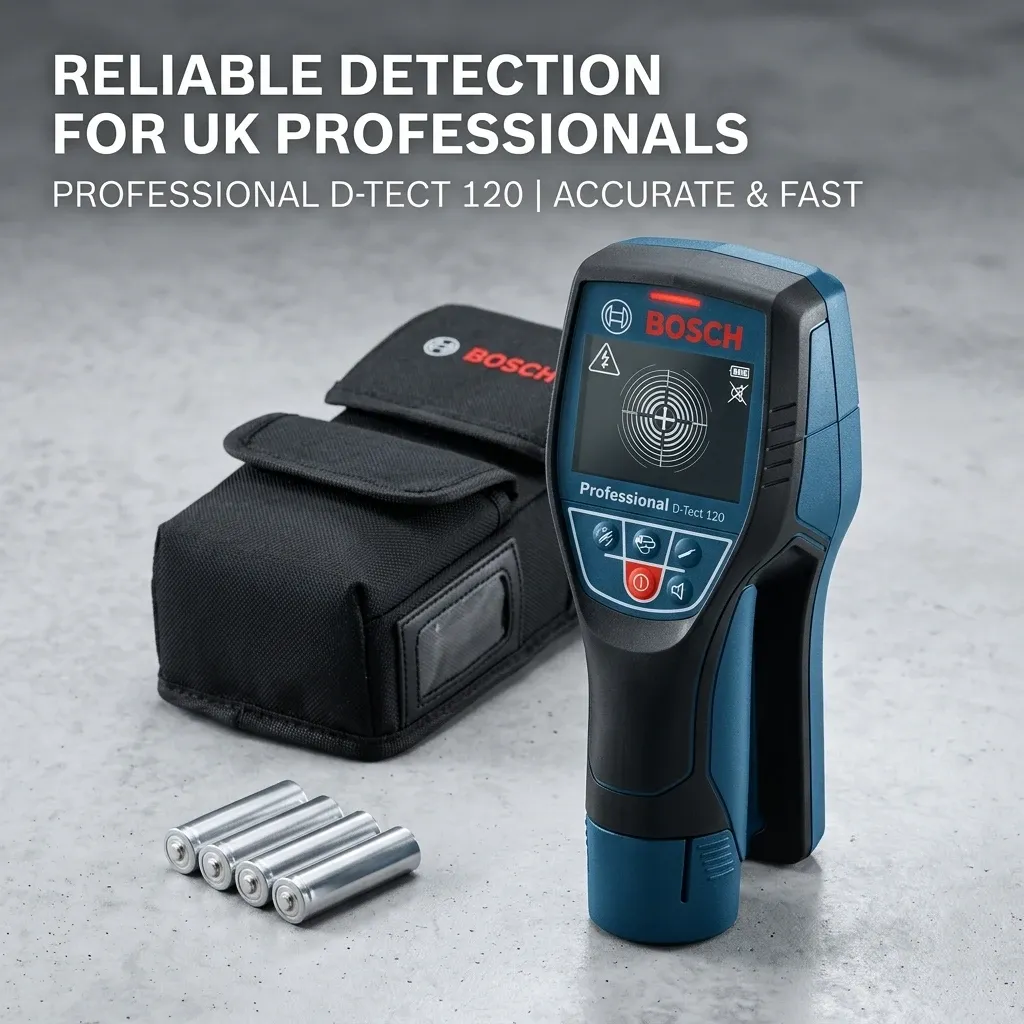
- Advanced radar technology, such as that found in the Bosch D-tect 120, provides millimetre-accurate detection of wooden studs, water pipes, and live wires.
- Adhering to safe drilling practices helps prevent costly repairs and serious injury, while also supporting good practice in line with UK guidance.
A wall stud detector finds studs, pipes and live cables hidden behind a wall, helping you drill safely and accurately in UK homes. Whether you are mounting a TV, hanging kitchen units or fitting shelves, the right scanner reduces guesswork and helps avoid damage.
Drilling a wall should be straightforward, but behind the surface of many British homes sits a hidden network of timber, pipework and wiring. According to Electrical Safety First, drilling into concealed wiring remains a serious DIY risk in the UK, so it is wise to check first rather than assume the wall is clear.
Therefore, if you want dependable results on plasterboard, dot-and-dab or older masonry, this guide explains what to look for in a wall stud detector and how to use one properly.
What does a wall stud detector do?
A wall stud detector is a handheld device used to locate framing studs, metal pipes and live electrical cables hidden behind wall surfaces. Early models often relied on magnets to find fixings in timber, whereas modern devices use sensors to identify changes in density and material behind plasterboard or masonry.
In the UK, this matters because wall construction varies widely. You might be dealing with a Victorian terrace with lath and plaster, a post-war semi with solid masonry or a new-build using dot-and-dab plasterboard. Consequently, a basic budget stud finder may give false readings, while a better scanner can handle a wider range of wall types.
What is the best wall stud detector for UK walls?
For most UK properties, the best wall stud detector is one that can scan for wood, metal, live cables and, ideally, pipes across different wall types. Based on our testing, radar technology is generally more dependable than simple edge-finding devices when walls are uneven, thick or built with mixed materials.
Why do UK walls need more advanced detection?
UK walls often include plasterboard, adhesive dots, masonry, plaster and hidden services in unpredictable positions. As a result, standard stud finders can struggle with depth, thickness and irregular voids.
Under BS 7671 safe-zone guidance, cables should normally run vertically or horizontally from sockets and switches. However, previous alterations are not always neat, so a proper scanner is a sensible safeguard before drilling.
In practice, a premium wall stud detector with multi-mode scanning is much more useful because it can help identify wooden studs, ferrous metals, non-ferrous metals and live AC cables.
Which wall stud detector technology is better?
When choosing a wall stud detector, you will usually see two main technologies: capacitive and radar. Understanding the difference will help you choose the right tool for your wall type and the level of accuracy you need.
Are capacitive stud finders any good?
Capacitive stud finders are common in entry-level models. They detect changes in wall density, so they can work well on simple hollow plasterboard walls. However, they often struggle on solid masonry, damp surfaces or walls with multiple layers, and therefore they are less reliable for more demanding UK jobs.
Is radar better than a standard stud finder?
Yes. Radar scanners emit ultra-wideband pulses that reflect off objects behind the wall, allowing deeper and more versatile detection. For solid walls and mixed construction, radar is usually the better choice. If you work on these surfaces regularly, read our radar wall scanner guide.
Similarly, for heavier-duty drilling into denser surfaces, a dedicated concrete wall scanner can help you avoid rebar and deep-set conduits.
Is the Bosch D-tect 120 a good wall stud detector?
The Bosch D-tect 120 is a strong choice for UK tradespeople and serious DIY users because it uses radar rather than basic edge-finding. That means it can spot objects without requiring a long sweep, which is especially useful in tight spaces or on awkward wall sections.
It can detect objects up to 120mm deep, including live cables, water pipes, wooden studs and metal framing. In addition, its centre finder helps you identify the middle of the object so your fixings land where they should. For a deeper breakdown, see our Ultimate Guide to Bosch D-Tect 120 in the UK.
How do you use a wall stud detector correctly?
Even a good wall stud detector can give poor results if it is not used properly. Therefore, follow these practical steps to improve accuracy:
- Calibrate first: Place the device flat against the wall and wait for it to reset before scanning.
- Move slowly: Quick sweeps can miss changes in density, so keep your movement steady.
- Check the wall type: Different settings may be needed for plasterboard, masonry or dot-and-dab walls.
- Do not trust one reading alone: Scan the same area more than once to confirm the result.
- Isolate power where possible: A detector can help, but it does not replace safe drilling practice.
According to UK guidance on safe drilling and electrical safety, you should always treat concealed services with caution. So, even if the detector shows a clear area, check the surroundings and proceed carefully.
What are the most common mistakes with wall stud detectors?
Several simple mistakes can lead to false readings or missed hazards. The most common are:
- Skipping calibration: This is one of the biggest causes of inaccurate results.
- Scanning too fast: A rushed pass can miss studs or cables altogether.
- Using the wrong mode: If your detector has multiple settings, choose the one suited to the wall and target.
- Assuming all cables are live: A detector only identifies live AC fields, so a switched-off circuit may not register in the same way.
- Relying on the tool alone: Visual checks, knowledge of safe zones and sensible drilling practice still matter.
Frequently Asked Questions
Can a wall stud detector find plastic water pipes?
Standard capacitive stud finders usually struggle with plastic pipes because they do not contain metal. However, radar-based detectors may sometimes help by identifying the space or object behind the surface, although results vary by wall type.
Will a wall stud detector work on dot-and-dab walls?
Yes, but some models perform much better than others. Radar scanners are generally more reliable on dot-and-dab walls because they cope better with uneven gaps behind the plasterboard.
Can a wall stud detector detect live electrical cables?
Many advanced models can detect live AC cables, but they should always be used as part of a wider safety check rather than as the only safeguard. If in doubt, isolate the circuit before drilling.
What is the difference between a stud finder and a wall scanner?
A stud finder usually focuses on locating wooden framing, while a wall scanner can detect a broader range of hidden objects such as pipes, cables and metal. For UK homes, a wall scanner is often the more practical choice.
Ready to try WallScanne?
Shop Now — £305.28